No. All three classes are treated as bicycles under Virginia law and don't require a driver's license, registration, or insurance.
Virginia E-Bike Laws and Regulations (2026 Update)
Written by: Tom Fortune | June 29, 2026 | Time to read 5 min
Virginia is broadly e-Bike-friendly, but the helmet rules for Class 3 e-Bikes and the mixture of local trail restrictions catch many riders off guard. Here's what you need to know.

More about the Author: Tom Fortune
Tom is a Brit living in the French Alps. When he's not creating written and video content for various brands, he's either pedalling or snowboarding around his local mountains. E-Bikes have unlocked the potential for Tom to explore Alpine terrain and get away from the crowded bike parks. He is only too keen to share his knowledge and experience with other riders.
Virginia's e-Bike rules have been in place since 2021 and haven't changed much since. There were no major updates in the 2025 legislative session, so the electric bike laws heading into 2026 is largely the same as it's been for a few years. The biggest developments have happened at the local level, particularly in Virginia Beach and around NOVA Parks.
Here's what you need to know about Virginia e-Bike laws and regulations.
How Virginia Defines an E-Bike
To count as an e-Bike under Virginia law, a bike needs fully operable pedals, an electric motor of no more than 750 watts, and no more than three wheels. If it fits those criteria, it's treated as a bicycle, not a motor vehicle, which means no registration, licensing, or insurance is required.
Go above 750 watts or ride faster than the assisted speed limit for your class, and the bike is deemed a moped or motorcycle, with all the paperwork that comes with it. Every e-Bike sold in Virginia must carry a permanent label showing the class, top assisted speed, and motor wattage.
The Three E-Bike Classes
| Class | Motor type | Max assisted speed | Speedometer required | Helmet required | Min age |
|---|---|---|---|---|---|
| Class 1 | Pedal-assist only | 20 mph | No | No statewide mandate* | None |
| Class 2 | Pedal-assist + throttle | 20 mph | No | No statewide mandate* | None |
| Class 3 | Pedal-assist only | 28 mph | Yes | Required for all riders | 14 (or supervised by adult 18+) |
*Riders aged 14 and under must wear a helmet on all classes statewide. Local areas may require helmets for older riders, too.
In all three classes, the motor must disengage when you stop pedaling or apply the brakes.
License and Registration Requirements
One of the great things about riding an electric bike in Virginia is that you don't need a license, registration, insurance, or plates. Virginia treats all three classes as bicycles. So as long as your bike meets the definition above, you're free to ride without having to deal with the DMV.
👋 Welcome to Upway!
Upway is your top destination for buying and selling e-Bikes online. Discover your next e-Bike at up to 60% off retail prices, available in new or like-new condition.
Where You Can Ride
The default in Virginia is straightforward: if a bicycle can be ridden there, so can your e-Bike. Roads, bike lanes, shoulders, and shared-use paths are all fair game across all three classes.
Where it gets more complicated is on specific paths and trails. Local authorities can restrict Class 1 and Class 2 from a path only after going through a formal notice-and-public-hearing process. Restricting Class 3 is simpler and doesn't require that same process. But natural-surface trails are ruled differently. They're managed by whoever owns or runs them, and many either ban e-Bikes outright or limit access to Class 1 only.
Sidewalks should be treated on a case-by-case basis. Virginia doesn't have a statewide ban on e-Bikes on sidewalks, but most urban areas have their own rules limiting sidewalk riding. When in doubt, check local rules before riding on a sidewalk.
E-Bikes in Virginia State Parks and Trails
Trail access in Virginia is more complicated than road access, and it varies a lot depending on where you're riding.
Virginia State Parks (DCR): Class 1 and Class 2 e-Bikes are permitted on trails and paths designated for bicycle use. Class 3 access varies by park, so look at the specific park's website before you go.
US Forest Service lands: The Forest Service treats e-Bikes as motor vehicles under federal policy. All classes are limited to motorized trails and forest roads. Non-motorized singletrack is off limits.
NOVA Parks: Class 3 e-Bikes are now permitted on NOVA Parks trails following updated state legislation. This was a considerable change from the previous policy.
W&OD Trail: Generally open to all e-Bike classes. Check posted signage for any local speed rules, as some busier sections have their own limits.
Virginia Creeper Trail: Policies have varied on this trail and continue to evolve. Check directly with trail management before riding.
Blue Ridge Parkway: This is National Park Service territory. E-Bikes are generally allowed on park roads and where regular bikes are permitted, but NPS rules can vary by section. Verify before riding.
Virginia Capital Trail: Generally open to all three classes.
Helmet Requirements
This is where Virginia is stricter than many states:
Class 3: Helmets are mandatory for all, regardless of age.
Class 1 and Class 2: No statewide helmet law for adults. That said, Virginia requires all riders aged 14 and under to wear a helmet on any class of e-Bike.
Several localities add their own rules on top of this. Loudoun County requires helmets for riders under 15. Fairfax County and Prince William County have similar age-based rules. But realistically, you should wear a helmet no matter what.
Age Requirements
Class 1 and Class 2 electric bikes have no minimum age requirement under Virginia state law.
For Class 3, riders must be at least 14 years old. A rider under 14 can operate a Class 3 e-Bike only when under the immediate supervision of an adult aged 18 or older. Given that Class 3 bikes can reach 28 mph of assisted speed, that rule makes sense.
Equipment Requirements
For riding after dark, Virginia requires a white front and a red rear light or reflector visible from a reasonable distance. Class 3 e-Bikes also need a speedometer. All e-Bikes must meet Consumer Product Safety Commission manufacturing standards.
Local Rules Worth Knowing
Virginia Beach: The city lifted its seasonal ban on e-Bikes along Atlantic Avenue in October 2025. E-Bikes are now allowed on the roadway year-round, just like traditional bikes. They still can't be used on the Boardwalk, the Boardwalk Bike Path, grassy areas next to the Boardwalk, Oceanfront parks and plazas, or sidewalks in the Resort Area and Town Center.
Loudoun County: Helmets are required for all riders under 15 on bicycles and e-Bikes in public places. The Loudoun County Sheriff's Office actively enforces e-Bike rules, so it's worth knowing the local requirements before you ride there.
Fairfax County and Prince William County: Both require helmets for riders under 15. Fairfax County Park Authority allows e-Bikes on park trails at a top assisted speed of 20 mph.
Arlington County: Launched an e-Bike voucher program in August 2025, offering up to $600 per bike, or up to $1,650 for income-qualified residents. Contact Arlington County directly for current availability.
State rebate: Virginia's Electric Vehicle Rebate Program includes e-Bikes, but it's been unfunded since early 2026. Check with your locality or utility provider for any local schemes that might be running instead.
Buying an E-Bike in Virginia
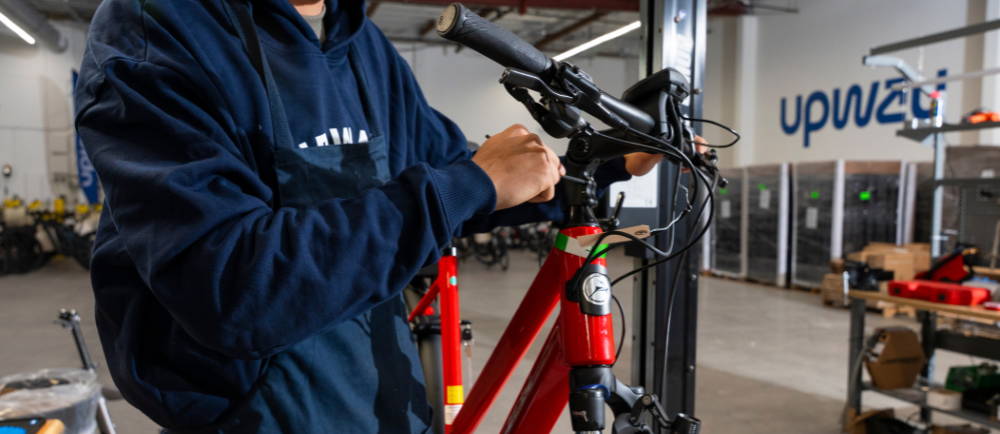
Virginia is a good state to own an e-Bike, and buying pre-owned is one of the most cost-effective ways in. Every e-Bike on Upway goes through a 50-point inspection before going on sale, and each listing shows the class label, motor wattage, and completed charge cycle count.
Virginia is more permissive than many states on registration and licensing, but the Class 3 helmet rules and local trail restrictions are worth getting your head around before you head out.
Browse Class 1 e-Bikes, Class 2 e-Bikes, or Class 3 e-Bikes on Upway, or explore electric mountain bikes and the full range of certified pre-owned e-Bikes available for Virginia riders.
Frequently Asked Questions
Do I need a license or registration to ride an e-Bike in Virginia?
Do I need to wear a helmet to ride an e-Bike in Virginia?
Class 3 riders must wear a helmet by state law. Riders aged 14 and under must wear a helmet in any class. Local areas, including Loudoun, Fairfax, and Prince William counties, may have stricter requirements.
What is the minimum age to ride a Class 3 e-Bike in Virginia?
14 years old. Riders under 14 can only operate a Class 3 under the immediate supervision of an adult aged 18 or older.
Are e-Bikes allowed on Virginia State Park trails?
Class 1 and Class 2 electric bikes are generally allowed on designated bicycle trails. Class 3 access varies by park. Always check the specific park's website before riding.
Can I ride my e-Bike on sidewalks in Virginia?
State law doesn't ban it, but most cities have their own rules. Virginia Beach bans e-Bikes on sidewalks in the Resort Area and Town Center. Check local rules before riding on sidewalks.
What changed in Virginia Beach in 2025?
City Council voted in October 2025 to allow e-Bikes on Atlantic Avenue year-round. Previously, they were banned during the resort season. The Boardwalk and Oceanfront areas remain off limits.
Key Takeaways
- Virginia treats e-Bikes as bicycles under state law, with no license, registration, or insurance required for any class. Class 3 riders must wear helmets, and all riders aged 14 and under must wear a helmet regardless of class.
- Trail access varies by class and land manager. Virginia State Parks welcome Class 1 and Class 2 on designated bicycle trails, but US Forest Service lands treat e-Bikes as motor vehicles. Always check before you ride.
- Local rules vary considerably throughout Virginia. Virginia Beach, Loudoun County, Fairfax, and Arlington all have their own rules on top of state law, so it's worth checking the specific area before you head out.