Yes. At 80%, the battery still has roughly four-fifths of its original capacity. The bigger question is whether that’s enough range for your riding and whether the price makes sense. Upway replaces batteries that test below 80% of original capacity.
What Is Good E-Bike Battery Condition When Buying Used?
Written by: Chris Van Leuven | September 21, 2026 | Time to read 5-6 min
What is a good e-Bike battery condition percentage when buying used? Learn what 80% means and what to check before buying a used electric bike.

More about the Author: Chris Van Leuven
Chris is a writer, climber, and founder of Yosemite E-Biking in Mariposa, CA. When he’s not tackling Sierra Foothills trails or scaling rock walls, he’s crafting adventure stories with his boxer, Fenster. His work has appeared in Outside, Men’s Journal, Gripped, and Best American Sports Writing.

An e-Bike battery doesn’t need 100% health to be worth buying used. That’s the first thing I’d clear up. Lithium-ion batteries lose some capacity as they age, so a used e-Bike with a battery at 90% of its original capacity isn’t necessarily a problem. Even 80% may be plenty, depending on the bike, the price, and how far you plan to ride. Below that, I’d start asking more questions.
In this blog, I’ll explain what battery condition, health, and capacity percentage actually mean. Plus, I’ll share why 80% is a useful number when shopping for a used or certified pre-owned e-Bike on Upway, and when a lower percentage should affect what you’re willing to pay.
👋 Welcome to Upway!
Upway is your top destination for buying and selling e-Bikes online. Discover your next e-Bike at up to 60% off retail prices, available in new or like-new condition.
Table of Contents
What Does E-Bike Battery Condition Percentage Mean?
Battery condition and battery charge aren’t the same thing. You can charge an older battery to 100% and still have less usable energy than when that battery was new. Say an electric bike originally came with a 500Wh battery. If testing shows that the battery can now hold about 450Wh, it has roughly 90% of its original capacity. The display can still say 100% after you charge it. You’re just starting with a smaller tank than you had when the battery was new.
Less capacity generally means less range, but how much that matters depends on your riding. Losing 10% of battery capacity may not matter if you have a five-mile commute. It matters more if you regularly push the battery to its limits on long rides. A percentage by itself doesn’t make a used battery good or bad.
🤝 Why you can trust us for buying an e-Bike?
- Great prices: Get your next e-Bike for up to 60% off retail prices, in new or like-new conditions.
- Quality Guaranteed: Every e-Bike is rigorously certified by a team of professional mechanics, and comes with a 1-year warranty.
- Delivered to Your Door: Delivered to your home within a week. Change your mind? Return it thanks to our 14-day return policy.
🚲 We also buy e-Bikes. Click here for an estimation!
Is 80% Battery Condition Good?
Think of 80% as a useful reference point. It’s also the line Upway uses when evaluating batteries on its pre-owned e-Bikes. Upway tests batteries during reconditioning and replaces one if diagnostics show less than 80% of its original capacity. Many e-Bikes on Upway are brand-new and operating at 100% of their original battery capacity, and for used models, we ensure that the battery you’ll receive is working great and at least 80% of its capacity.
Take a 500Wh battery. At 80% health, you’re looking at roughly 400Wh of remaining capacity. Whether that’s enough depends on where you ride and how far you go, but in general it indicates that there’s still plenty of miles and years of excellent battery performance ahead.
Here’s a useful way to look at it:
| Battery health | What it means when buying used |
|---|---|
| 90–100% | Capacity alone shouldn’t raise many concerns |
| 80–89% | Consider the bike, price, and range you need |
| Below 80% | Check replacement cost before buying |
| Unknown | Get more information before assuming the battery is healthy |
I wouldn’t pay the same amount for otherwise identical used e-Bikes if one had a battery at 95% health and the other was at 70%. But the lower number doesn’t automatically kill the deal. Maybe you only ride 10 miles at a time, or the bike is substantially cheaper, and you’ve already factored in a future battery replacement.
What Else Does the Percentage Tell You?

Battery age, charge cycles, mileage, and how the bike has been used can add some context. But high mileage doesn’t automatically mean the battery is finished. I’ve seen that directly with my own e-Bike tour fleet in California’s Sierra Foothills. I have 14 batteries, and they’ve seen heavy use over multiple seasons. My main guide bike recently passed 7,000 miles, with the same battery used for much of that riding. It still holds a charge well enough that I haven’t had a reason to retire it.
That said, I carry a spare battery on every ride for every bike. If we’re out half a day (30+ miles) or all day (60+ miles) and doing a lot of climbing (which is common here), I can swap batteries instead of trying to wring every last mile out of one. So I’m not going to use my fleet to claim that a battery should last 7,000 miles. I also haven’t run capacity diagnostics on every battery. What my experience does tell me is that I wouldn’t look at a used e-Bike with a lot of miles and assume the battery is shot.
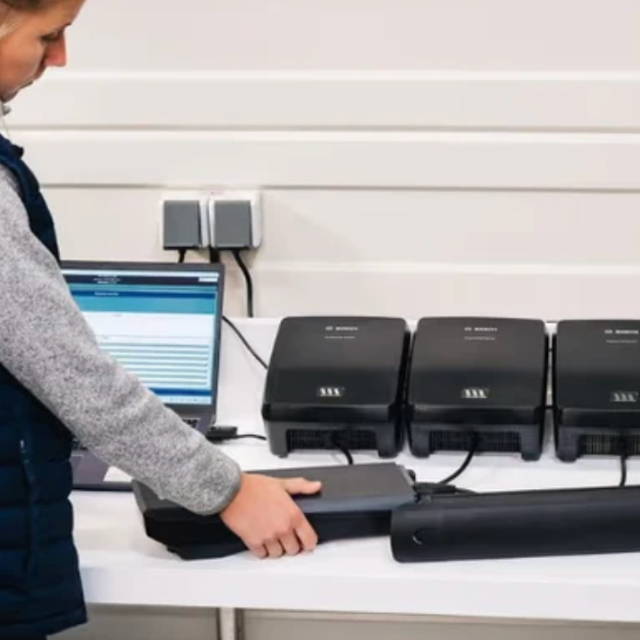
If proper diagnostics are available, those numbers are more useful than guessing from the odometer. That’s why Upway uses diagnostic software to check battery health, including Bosch software and hardware on compatible Bosch-equipped e-Bikes.
A short test ride has limits too. You can ride around the block and have the motor work perfectly without learning exactly how much of the battery’s original capacity remains. I’d still take the test ride. But I wouldn’t use it as proof that the battery is healthy.
When to Be Cautious About a Used Battery

Battery health is only part of it. Swelling, cracks, impact damage, heavy corrosion, questionable repairs, or modifications would concern me a lot more than whether a battery tests at 82% or 92%. You’ll also want the correct charger and to make sure the battery actually belongs with that e-Bike. If everything looks normal, then I’d look at remaining capacity, replacement availability, and price.
Say the battery tests at 75%. It may still work perfectly well for shorter rides, but the price ought to reflect that lost capacity. Before buying, find out what a compatible replacement costs and whether one is still available. That's easy to overlook with older electric bikes. Some use batteries from established manufacturers such as Bosch. Others rely on proprietary battery packs, and the company that made the bike may have changed systems or disappeared entirely.
A cheap used e-Bike gets expensive fast or time-consuming if the battery is worn out and a replacement is hard to find.
Why Battery Testing Matters When Buying Used on Upway
A private seller may know the battery age, approximate range, or even the number of charge cycles. What they may not know is how much of the battery’s original capacity remains. That’s why Upway checks that before selling the bike. Its mechanics use diagnostic software to determine battery condition and capacity, and replace batteries testing below 80% of their original capacity. Upway e-Bikes also come with a 1-year warranty and a 14-day return policy.
Frequently Asked Questions
Is 80% battery condition good for a used e-Bike?
Is it okay to buy a used e-Bike with less than 80% battery condition?
Possibly. If the bike is priced accordingly and the remaining range works for you, it may still make sense. But check the cost and availability of a replacement battery before buying.
Does high mileage mean an e-Bike battery is bad?
Not necessarily. My own tour fleet includes a bike with more than 7,000 miles, and its longtime battery still works well enough to remain in service. Mileage gives you some history, but it doesn’t tell you how much capacity is left.
Key Takeaways
- Battery condition and charge level aren’t the same thing. A battery can charge to 100% while holding less energy than it did when new.
- 80% is useful context, not an expiration date. Below that, pay closer attention to range, price, and replacement cost.
- Don’t judge a used battery from mileage alone. Remaining capacity tells you more about what you’re actually buying.