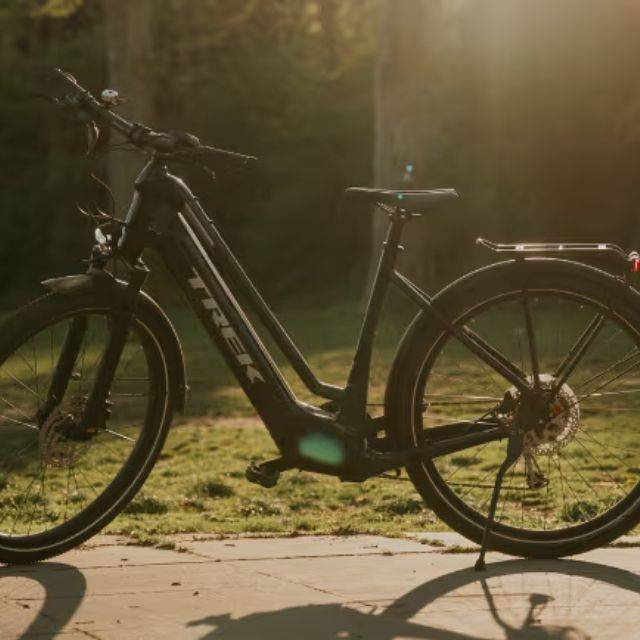
Both brands build high-quality e-Bikes, but they have different strengths. Trek gives you a wider spread of categories and stronger U.S. dealer access, while Haibike is especially attractive if you want a trekking or mountain bike with a more performance-focused identity.
Trek vs Haibike: Which E-Bike Brand Is Right For You?
Written by: Tom Fortune | March 31, 2026 | Time to read 5 min
Trek and Haibike both build impressive electric bikes, but they come from different corners of the cycling world, and that shows in their motor choices, model mix, and the way their bikes ride.

More about the Author: Tom Fortune
Tom is a Brit living in the French Alps. When he's not creating written and video content for various brands, he's either pedalling or snowboarding around his local mountains. E-Bikes have unlocked the potential for Tom to explore Alpine terrain and get away from the crowded bike parks. He is only too keen to share his knowledge and experience with other riders.
I’ve known about Trek for a long time, but I remember seeing my first Haibike parked outside a mountain refuge while hiking to Chamonix and realizing how good these things must be to get up there.
If you’ve been researching electric bikes, Trek and Haibike are two names you’re likely to run into quickly. Trek has a huge presence in the U.S. and covers everything from city bikes to long-travel e-MTBs, while Haibike has built much of its reputation around performance-oriented e-Bikes and helped pioneer the modern e-MTB category.
The brands overlap in a couple of categories, but they do not approach them in exactly the same way. Trek tends to spread its attention across a wider range of uses, while Haibike is more into sporty trekking bikes and e-mountain bikes.
In this guide, I’ll break down how Trek and Haibike e-Bikes compare so you can decide which brand makes more sense for the kind of riding you actually do.
👋 Welcome to Upway!
Upway is your top destination for buying and selling e-Bikes online. Discover your next e-Bike at up to 60% off retail prices, available in new or like-new condition.
About Trek Electric Bikes
Trek is an American bicycle brand founded in Wisconsin in 1976. Its current electric range includes urban and commuter bikes, cargo bikes, road and gravel models, and several families of electric mountain bikes. Trek also sells through a large dealer network, which makes it easier to find service, warranty support, and, in many cases, a local test ride before buying.
Trek has also been part of some of the more interesting e-Bike developments of the last few years. The Fuel EXe helped push the lightweight e-MTB category forward with the TQ HPR-50 system, and Trek’s e-Bike ecosystem now splits between Bosch’s app environment on Smart System bikes and Trek Central on other models.
About Haibike Electric Bikes
Haibike is a German brand founded in 1995. It became widely known in the e-bike world with the launch of the eQ XDURO in 2010, one of the first high-performance electric mountain bikes to gain real traction. By combining a mid-drive motor with proper mountain bike geometry, it helped shape what modern e-MTBs look like today.
That legacy still influences Haibike’s lineup. While the brand now covers a broad range of electric bikes, it maintains a strong focus on sporty trekking bikes and electric mountain bikes.
Haibike has also remained visible in recent product coverage. Its ALLMTN CF 11 TRN/IQ has received design and innovation recognition, and the brand continues to release Bosch-equipped models such as the Adventr, while also supporting updates tied to the Bosch Smart System.
Bike Comparison: Trek vs Haibike
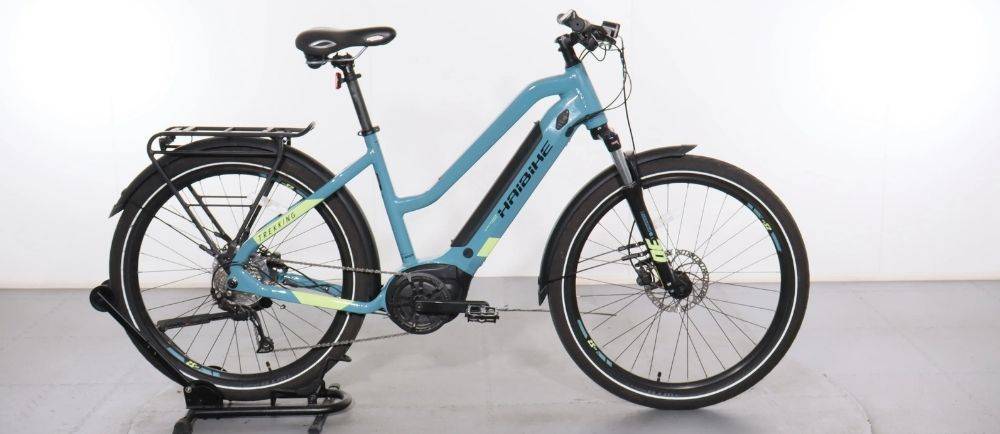
Trek and Haibike both build premium e-Bikes, but the similarities start to thin out when you look at their motors, frame styles, and the breadth of each lineup. Trek has a more rounded catalog for everyday use, while Haibike is more about trekking and off-road performance.
Motor Type & Ride Feel
Trek uses several different drive systems depending on the bike. For example, many of its commuter and full-power mountain bikes use Bosch motors, while the Fuel EXe and Slash+ use the TQ HPR-50, a compact 50 Nm motor aimed at riders who want a quieter, lighter feel than a full-power setup. Trek’s FAQ also notes that Bosch Smart System bikes work with the Bosch Flow app, while other Trek e-Bikes connect through Trek Central.
Haibike is even more mixed. Its current collection includes Bosch, Yamaha, Fazua, and Pinion-equipped bikes. Trekking bikes such as TREKKING 7 and TREKKING 9 ABS use Bosch; some models, like TREKKING 5 and ALLMTN 7, use Yamaha; the LYKE family uses Fazua Ride 60; and the ALLMTN CF 11 TRN/IQ uses Pinion’s integrated motor-gearbox unit.
That means Trek feels more consistent across its range, while Haibike gives you more variety in how the motor character changes from one model to another. If you want one brand with a very broad spread of motor personalities, Haibike is the way to go. If you want something more unified and easier to understand from the shop floor to trail, Trek is much simpler.
Features & Equipment
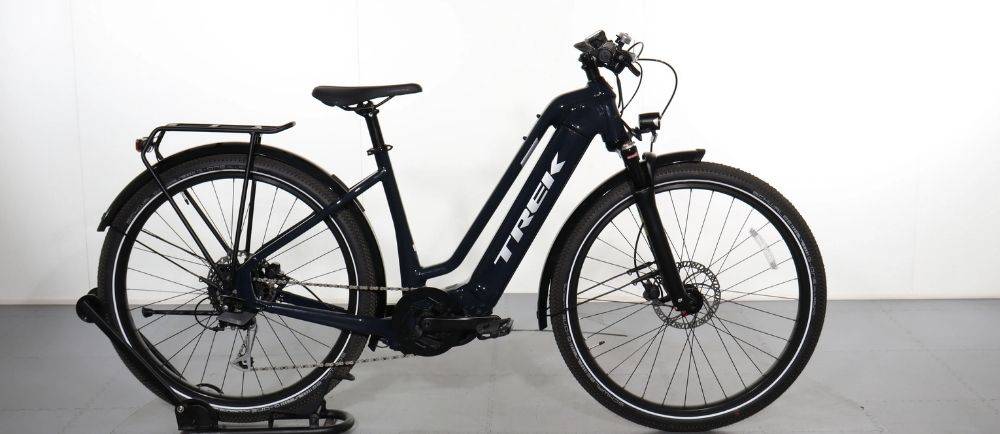
Trek’s commuter and utility bikes usually come with the practical extras most daily riders want. The Allant+ family sits at the premium end of Trek’s commuter range, which comes with racks, fenders, and lights. The Fetch+ family goes beyond regular commuter bikes with serious family- and utility-focused features.
Haibike’s trekking bikes also arrive well equipped, but the emphasis is a little different. The TREKKING and ADVENTR families are for longer rides, mixed surfaces, and comfort with off-road capability rather than pure city use. Haibike also has features like its Modular Rail System and eConnect on some models, which give them a more tech-heavy feel than many traditional commuter bikes.
Braking & Comfort
Trek’s commuter bikes add comfort through upright positions and practical accessories, while its mountain lineup ranges from short-travel trail bikes to long-travel enduro beasts.
Haibike pushes harder into specialized off-road categories. The collection splits into ALLTRACK hardtails, ALLTRAIL full-suspension trail bikes, ALLMTN all-mountain bikes, HYBE long-travel bikes, LYKE light e-MTBs, and NDURO freeride/enduro models. On the comfort side, its trekking bikes and Adventr family add a more relaxed, more practical side to the brand.
Battery Design & Range
Trek typically integrates the battery into the downtube, but many models have a removable battery for easy charging and storage. Battery and range vary widely by category: a lightweight bike like the Fuel EXe uses a smaller battery to keep weight down, while higher-power mountain and cargo bikes use larger packs.
Haibike uses integrated batteries, but its current range has various battery sizes. For example, when you look at the spec sheets, you’ll see Bosch PowerTube 500 Wh, 600 Wh, and 800 Wh, Fazua 480 Wh, and Yamaha 720 Wh options, which tells you just how varied the brand’s current lineup is.
Motor Power and E-Bike Classes
Trek’s U.S. range covers both Class 1 and Class 3 bikes. Class 1 has pedal assistance up to 20 mph, and Class 3 has pedal assistance up to 28 mph. The Allant+ range, for example, assists you up to 28 mph, while many Trek mountain bikes are Class 1 trail bikes.
Haibike’s classes depend more on the market and model. Many of its international bikes are sold around the European 25 km/h standard, but some have the faster Bosch Performance Line Speed motor. In other words, Trek is easier to understand for U.S. classes, while Haibike can vary more depending on where it's sold.
Price and Positioning
Price is one of the main differences between Trek and Haibike.
Trek covers a wide range of price points. Entry-level electric bikes such as the FX+ and Verve+ typically start around $2,000–$3,300, while more powerful commuter models like the Allant+ range usually fall between $3,500 and $6,500. Electric mountain bikes such as the Rail and Slash+ can range from around $5,500 to well over $10,000, depending on the spec.
Haibike sits more firmly in the mid-range to premium category in the U.S. Entry-level models typically start around $3,000–$4,000, while many trekking and full-suspension e-MTBs fall between $4,000 and $6,500. Higher-end models with Bosch Performance Line CX motors, carbon frames, or Pinion systems can push into the $6,500 to $10,000+ range.
Trek is often the easier entry point into e-Bikes, while Haibike appeals more to riders willing to spend a bit more for off-road capability or a sportier ride feel.
If you’re browsing on Upway, you’ll often see both Trek and Haibike models priced noticeably lower than new retail. Trek commuter bikes can typically be found from around $1,500–$3,000, while higher-end models like the Allant+ or Rail often fall between $3,000 and $6,500 depending on condition and spec. Haibike models on Upway usually start around $2,200–$3,500, with full-suspension e-MTBs commonly listed between $3,500 and $7,500+. Because these bikes are certified pre-owned, savings of 20–50% are common compared to new prices.
Popular E-Bike Models
Both brands offer e-Bikes across several categories.
Commuter and Urban Models
Trek
- Verve+ – A comfort-focused commuter e-Bike with an upright riding position.
- Allant+ – A high-performance commuter e-Bike with integrated accessories and higher-speed options.
- FX+ – A lightweight urban e-Bike for commuting and fitness riding.
- Dual Sport+ – A hybrid e-Bike for pavement, paths, and light gravel.
Haibike
- TREKKING – A broad trekking range of e-Bikes aimed at commuting, leisure riding, and longer mixed-surface rides.
- ADVENTR – A full-suspension eSUV-style bike aimed at exploring, comfort, and off-road-capable trekking.
Road and Gravel Models
Trek
- Domane+ – An electric road bike for endurance riding.
- Checkpoint+ – A gravel e-Bike built for mixed terrain.
Haibike
- Haibike does not currently offer a dedicated road or gravel e-Bike, though some of its lighter models overlap with gravel-style riding.
Cargo Bikes
Trek
- Fetch+ 2 – A longtail cargo bike for carrying passengers and gear.
- Fetch+ 4 – A front-loading cargo bike built for heavy loads and family use.
Haibike
- Haibike does not currently have a dedicated cargo bike.
Electric Mountain Bikes
Trek
- Rail – A full-power electric mountain bike for steep climbs and technical trails.
- Fuel EXe – A lightweight trail e-MTB with a quieter, lower-power motor.
- Powerfly – A range of hardtail and full-suspension electric mountain bikes for mixed terrain.
- Slash+ – A long-travel electric mountain bike for aggressive riding.
- Marlin+ – An entry-level hardtail electric mountain bike for newer riders and light trails.
- E-Caliber – A lightweight cross-country electric mountain bike built for speed and efficiency.
Haibike
- ALLTRACK – A hardtail eMTB with Bosch CX motors and trail-friendly geometry.
- ALLTRAIL – A full-suspension trail e-MTB available in Bosch and Yamaha versions.
- ALLMTN – An all-mountain that now stretches from Bosch and Yamaha bikes to the award-winning TRN/IQ version.
- HYBE – A long-travel eMTB with Bosch CX, Bosch CX-R, and Yamaha variants in the current collection.
- LYKE – A lightweight carbon e-MTB built around the Fazua Ride 60.
- NDURO – A gravity-focused e-MTB aimed at freeride and more aggressive descending.
Shop Trek and Haibike E-Bikes at Upway
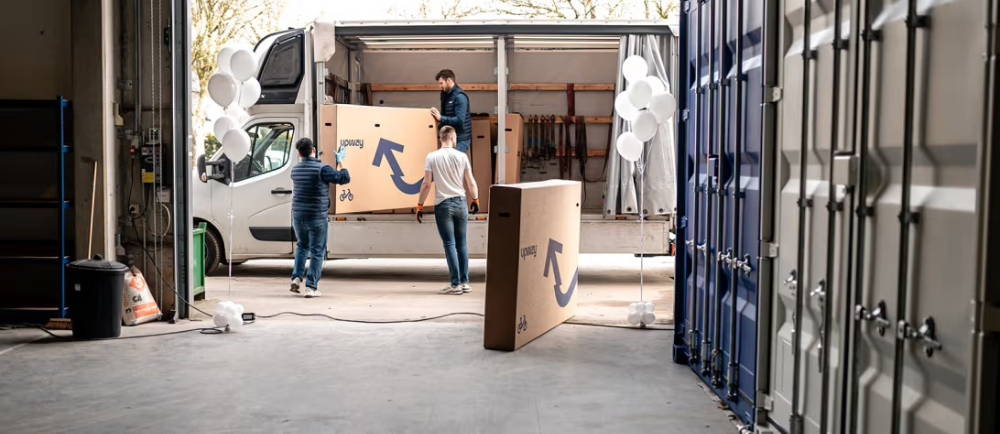
If you’re choosing between Trek and Haibike, you may want to check out some certified pre-owned bikes from Upway. This option can make a big difference, especially once you move into premium e-MTB and trekking territory. Upway’s website lets you compare different brands, motor systems, battery sizes, and frame styles from home. The main advantage of this is that a refurbished option can make those higher-end models much more realistic without paying full retail. You also get peace of mind from fast and secure shipping and the included warranty.
Frequently Asked Questions
Are Trek e-Bikes better than Haibike?
Do Trek and Haibike both use Bosch motors?
Yes. Both brands use Bosch widely, but Trek also uses TQ and hub-motor systems in parts of its range, while Haibike currently mixes Bosch with Yamaha, Fazua, and Pinion depending on the spec.
Which brand is better for electric mountain bikes?
Both are strong here. Trek offers a very broad range of mountain bikes, from the lighter Fuel EXe to Rail+ and Slash+, while Haibike has one of the deepest eMTB catalogs, with the ALLTRACK, ALLTRAIL, ALLMTN, HYBE, LYKE, and NDURO families.
Key Takeaways
- Trek and Haibike both make high-quality e-Bikes, but Trek spreads its attention across more categories, while Haibike leans harder into trekking and mountain riding.
- Trek stands out for its dealer network, broad U.S. coverage, and its mix of Bosch, TQ, and light-urban systems. Haibike stands out for its deep eMTB catalog, broad motor mix, and its long history as an early ePerformance brand.
- Choosing between them usually comes down to whether you want wider everyday versatility and stronger U.S. shop access, or a brand that puts more of its energy into trekking and off-road performance.