Riders must be at least 16 years old to legally operate a Class 3 electric bike in Denver, Colorado.
Denver E-Bike Laws and Regulations: 2026 Guide
Written by: Kazim Ladimeji | May 20, 2026 | Time to read 6 min
As a resident or visitor to Denver, Colorado, it’s essential to understand the city’s electric bike laws, which outline important compliance areas such as speed limits, helmet rules, trail access, sidewalk usage, and age restrictions.

More about the Author: Kazim Ladimeji
Kazim is a UK-based cyclist and writer who discovered his passion for riding during lockdown six years ago and hasn’t looked back since. He now rides around 100 miles a week, exploring road and light gravel routes from his base in the Cotswolds, a cycling paradise. When he’s not riding or writing about e-Bike trails in the US, he’s exploring cafés, cooking, and keeping busy as a soccer dad

Denver follows Colorado State’s three-class electric bike system, but the city has also introduced additional local ordinances around sidewalk usage, parking, and shared e-Bike safety. Riders should understand both the statewide rules and Denver’s city-specific regulations before using an electric bike in the area.
In Denver, electric bikes are widely used for commuting, errands, and recreational riding, with access to an extensive network of bike lanes, greenways, and urban cycling infrastructure. However, increasing e-Bike usage has also led to tighter regulations around safety and public space usage.
In this article, I will summarize the key Denver e-Bike laws in a practical and easy-to-understand way, so you can stay compliant and ride safely.
👋 Welcome to Upway!
Upway is your top destination for buying and selling e-Bikes online. Discover your next e-Bike at up to 60% off retail prices, available in new or like-new condition.
Table of Contents
What are the e-Bike traffic rules for Colorado State?
How does Denver classify an electric bicycle?
Can I ride an electric bike on a sidewalk in Denver?
Are lights and reflectors a legal requirement in Denver?
What is the new sidewalk detection technology around shared e-Bike usage in Denver?
What is Denver’s local ordinance around parking shared e-Bikes?
Frequently Asked Questions
What are the e-Bike traffic rules for Colorado State?
Being in Colorado, Denver is subject to the Colorado Department of Transportation’s (CDOT) regulations regarding electric bike usage. This E-Bike Safety Campaign was designed to encourage the safe usage of electric bicycles across the state of Colorado. It includes a combination of digital and print educational documents focused on legal compliance and e-Bike safety.
Here are the main state laws:
Colorado uses a three-class electric bike system: Class 1, Class 2, and Class 3
- Helmets are legally required for all Class 3 riders
- Class 1 and Class 2 e-Bikes can generally be used wherever traditional bicycles are permitted
- Class 3 e-Bikes are usually restricted to roads, highways, and specifically designated bike paths
Legal e-Bikes in Colorado must:
- Have operable pedals
- Use a motor rated at 750 watts or less
- Remain within the legal speed limits for their class
Additional points to note:
- Any electric bike exceeding 28 mph or 750 watts is classified as an e-Moto or motor vehicle. (E-Motos require registration, insurance, and a valid driver’s license.)
- Modifying an e-Bike beyond factory speed or power limits is illegal and can result in fines.
- Colorado law requires sellers to clearly disclose the bike’s class, top assisted speed, and motor wattage at the point of sale.
However, Denver has established its own local ordinances and additional regulations regarding e-Bike usage in the city in response to crash statistics and conflicts over public space on streets and sidewalks.
How does Denver classify an electric bicycle?
Denver adheres to Colorado State’s three e-Bike class systems (Class 1, Class 2, and Class 3) to classify bicycles with electric assistance.
- Class 1 electric assist bicycle: Pedal-assist only with a maximum speed of 20 mph.
- Class 2 electric assist bicycle: Throttle and pedal assist with a maximum speed of 20 mph.
- Class 3 electric assist bicycle: Pedal assist only with a maximum speed of 28 mph. Riders must be at least 16 years old, and helmets are mandatory.
Can I ride an electric bike on a sidewalk in Denver?
Electric bikes are not allowed on sidewalks apart from the following exceptions:
- The sidewalk must be part of a designated bike route
- The operator is preparing to dismount and park the bike in the current location or block
When on a sidewalk, riders must always yield the right of way to pedestrians and there is a general speed limit of 6 mph.
Are lights and reflectors a legal requirement in Denver?
Electric bikes being used from dusk until dawn must have:
- A front light
- A rear red reflector
- Reflective material on the sides of the bike
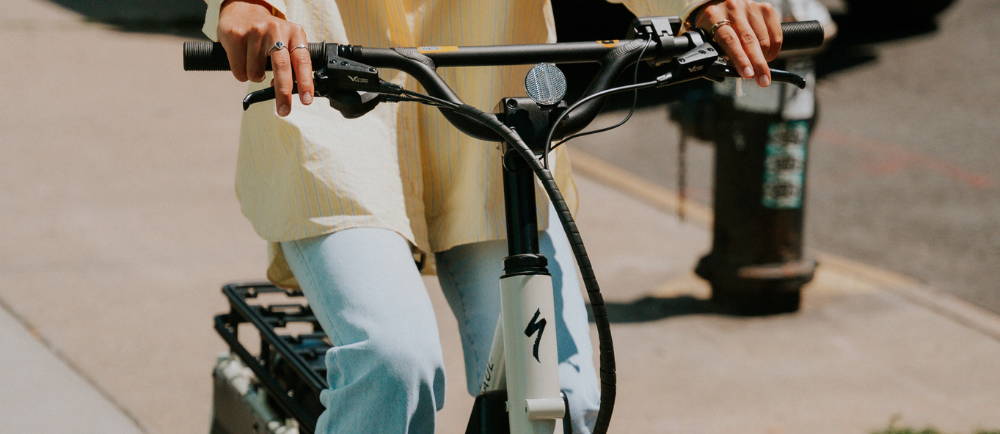
What is the new sidewalk detection technology around shared e-Bike usage in Denver?
On May 21, 2025, Denver City passed a local ordinance requiring shared e-scooters and shared e-Bikes operating in the city to have sidewalk detection technology and to be parked in specific designated locations.
The ordinance is due to take effect from July 1, 2026, and applies to Veo, the vendor operating Denver City’s shared e-Bike and e-scooter programme.
The purpose of the technology is to keep shared e-scooter and shared e-Bike riders off sidewalks and reduce congestion in high-traffic pedestrian areas such as Five Points and downtown Denver.
When users ride shared electric bikes or scooters on sidewalks, they may hear an audio warning telling them to get off the sidewalk. The technology can also slow the bike down, stop it, or end the ride completely. Repeated violations may result in account suspension, educational tutorials, quizzes, or fines.
What is Denver’s local ordinance around parking shared e-Bikes?
Denver has introduced stricter parking rules due to concerns around shared electric bikes being abandoned irresponsibly on sidewalks and public streets, creating trip hazards and accessibility problems.
As a result, the new ordinance requires shared bike users to park bikes in mandatory parking zones, particularly in downtown Union Station and Central Business District neighborhoods. Shared bike users cannot end their rides until the bike is parked correctly.
Frequently Asked Questions
How old do you have to be to operate a Class 3 e-Bike in Denver, Colorado?
Are helmets required when riding an electric bike in Denver?
Helmets are mandatory for Class 3 e-Bike riders. CDOT strongly recommends helmets for all riders, regardless of e-Bike class.
Can I ride an electric bike on Denver sidewalks?
Yes, but only under limited conditions. Riders must travel slowly (maximum 6 mph), yield to pedestrians, and only use sidewalks where permitted under Denver’s local ordinance.
Key Takeaways
- Denver follows Colorado’s three-class electric bike system, but also applies additional city-specific regulations.
- Denver applies strict rules around sidewalk riding, including a 6 mph speed limit.
- Shared e-Bikes in Denver will soon use sidewalk detection technology and mandatory parking zones.